Before selecting a compactor or establishing its operating conditions, it is essential to understand how the product responds during compaction. Flowability, bulk density, moisture, cohesion and mechanical strength can vary from one formulation to another, affecting both equipment feeding and the characteristics of the compacted material.
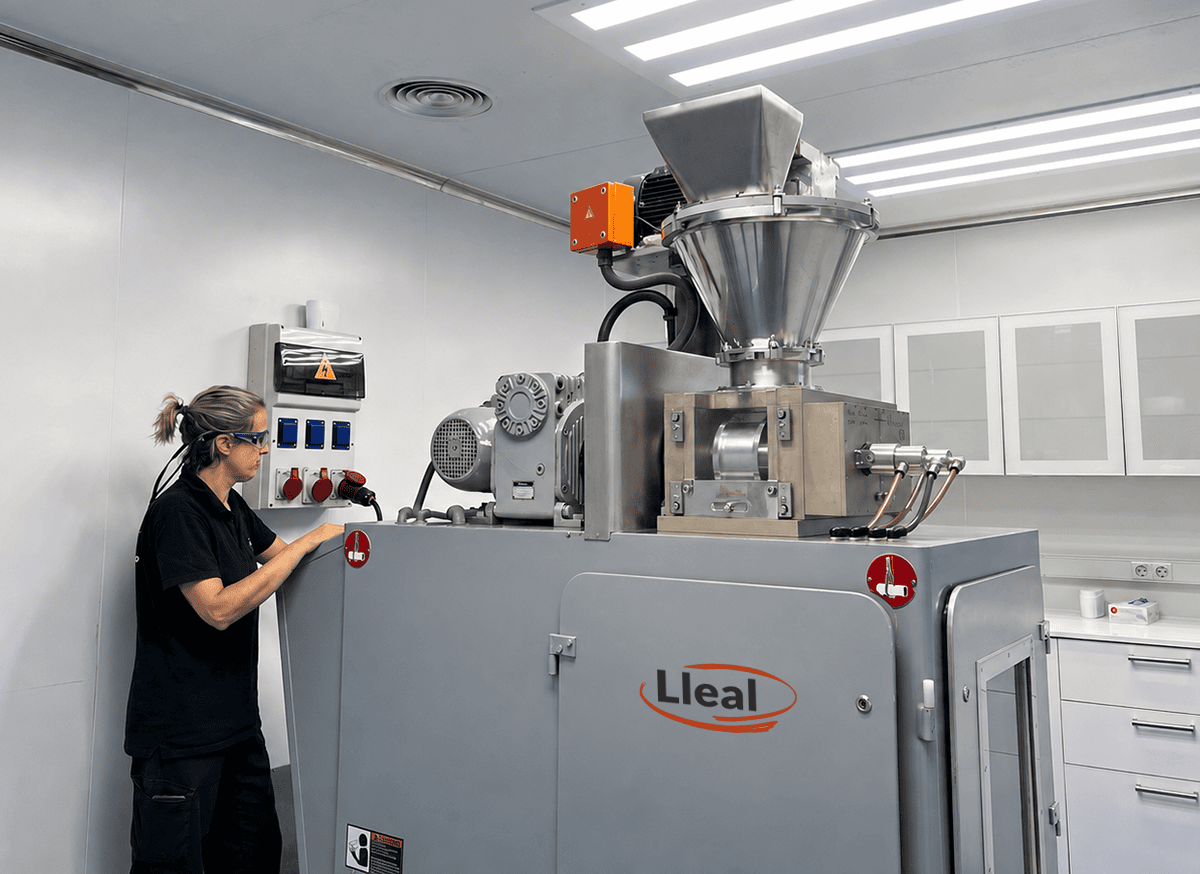
Compaction trials carried out with the customer’s own product make it possible to study these variables in a controlled environment. The results can be used to assess process feasibility, identify potential formulation adjustments and obtain useful information to guide equipment selection. To illustrate how this work is carried out, we present the procedure followed by Lleal’s industrial testing laboratory, based on recent trials with three plant-based formulations intended for an industrial application related to animal feed.
Why carry out a compaction trial before defining the process?
Materials with a similar appearance can behave very differently during powder compaction. Their response depends on their physical properties, composition and the conditions applied during the process.
For this reason, a laboratory trial does more than verify whether the product is suitable for compaction. It also enables the material’s behaviour to be analysed during feeding, compaction and subsequent operations such as granulation.
Every trial is unique. Although the working methodology is shared, the equipment selection, process conditions and tests performed are adapted to the characteristics of each product and the customer’s specific objectives. This approach provides relevant technical information for each application and supports decision-making before moving towards industrial scale-up.
Among other things, a compaction trial can help to:
- Verify the technical feasibility of the operation.
- Assess the product’s flowability and consistency during dosing towards the rollers.
- Study its response under different operating conditions.
- Assess the continuity and stability of the ribbon produced.
- Detect potential problems with material cohesion or brittleness.
- Assess the behaviour of the binder and check whether its dosage provides the required cohesion.
- Obtain samples for subsequent evaluation.
- Define the project’s next steps.
This information is especially valuable when working with a new raw material or one with no previous processing history.
How is a compaction trial planned?
Defining the trial objectives and requirements
Trial requests are received by the laboratory through Lleal’s internal project management platform. The Sales Department records the scope of the trial, the objectives to be achieved and the customer’s specific requirements.
In the case analysed, the main aim was to improve the product’s flowability by increasing its bulk density.
The formulations contained a binder. The trial therefore also had to provide information to assess:
- The suitability of the binder used.
- The appropriateness of its dosage.
- The cohesion achieved during compaction.
- The material’s strength during subsequent granulation.
- Compliance with the characteristics required for its application.
Defining these objectives before starting makes it possible to select the equipment, establish a working methodology and determine which observations will be relevant when evaluating the result.
Reviewing technical and safety information
Where appropriate, the request is accompanied by safety data sheets, known as SDS or MSDS, and technical data sheets for the raw materials, or TDS.
Reviewing this documentation provides an understanding of the product’s characteristics, identifies potential risks associated with its handling and establishes the necessary preventive measures.
This stage is intended to protect laboratory personnel, preserve the integrity of the equipment and prevent incidents that could affect other activities carried out at the company’s facilities.
The materials’ technical information also helps define the initial trial methodology. However, when no processing history is available, the operating conditions are adjusted progressively according to the material’s observed behaviour.
Which variables are analysed in a compaction trial?
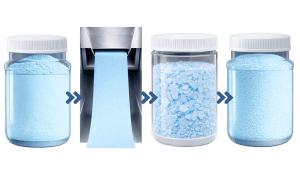
Compaction densifies a powder product through the controlled application of force between rollers. The material forms a ribbon that can subsequently be used directly or pass to another stage, such as industrial granulation.
The result does not depend on a single parameter. It is necessary to study the interaction between the product characteristics, the formulation and the operating conditions configured on the equipment.
Variables that may be relevant during a compaction trial include:
- Product flowability.
- Feed consistency.
- Feed speed.
- Roller speed.
- Compaction force.
- Cooling circuit temperature.
- Continuity of the ribbon produced.
- Bulk density achieved.
- Cohesion of the compacted material.
- Throughput achieved during the trial.
These variables help determine whether the product can be processed reliably and whether the characteristics of the resulting compact are suitable for subsequent stages.
What information does a compaction trial provide?
One of the laboratory’s main contributions is to interpret the results obtained and turn them into useful information for decision-making. A compaction trial can confirm the technical feasibility of a process while highlighting areas for improvement, whether through adjustments to the operating conditions or to the product formulation itself.
The conclusions may point to different lines of work, such as adjusting process parameters, reviewing the formulation or assessing new alternatives before industrial scale-up.
The final assessment rests with the customer, who determines whether the results meet their process requirements and application specifications.
Technical report and trial traceability
During the trial, the operating parameters and observations relating to the behaviour of each formulation are recorded.
Once the tests are complete, our technical team prepares a report that includes:
- The machinery and configuration used.
- The operating conditions.
- The parameters recorded.
- The observations made during the process.
- The compaction and granulation results.
- The conclusions and potential lines of work.
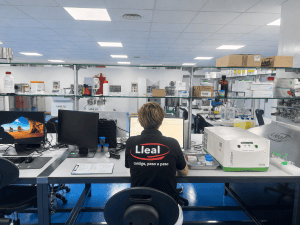
This report is sent to the customer for evaluation and archived in Lleal’s document management system. This procedure ensures trial traceability and makes it easier to consult the information during future stages of the project.
From trial to process definition
A compaction trial reveals the actual response of a raw material before an industrial process is defined. In addition to verifying whether the product can be processed, it helps identify the variables affecting the operation and provides the information needed to make well-founded decisions from the earliest stages of the project.
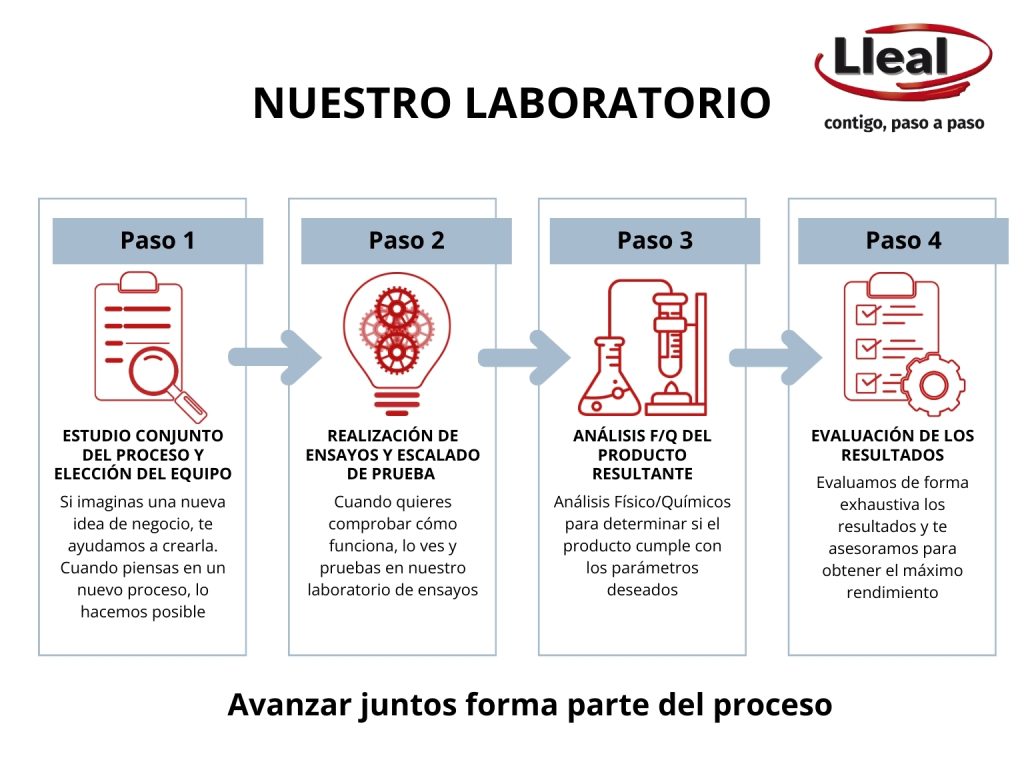
Lleal’s industrial testing laboratory studies each project based on the product characteristics, the customer’s objectives and the demands of the application. The information obtained makes it possible to select the most suitable technology, establish initial process conditions and determine whether the formulation or process conditions need to be adjusted before moving on to the next development stage.
When there is no history of similar trials, testing with the actual product is the first step towards making technically sound decisions. This approach minimises risk, establishes the most suitable process conditions and reduces uncertainty before implementation on an industrial scale.